
Illustrative artwork for education and context.
A developed system of care
Ayurveda’s classical literature describes ways to observe a person, understand patterns, and select among food, routine, botanicals, and traditional procedures. Its approach is more detailed than a single massage or supplement. The first question is often what has changed in the person’s life and bodily experience; the choice of technique follows from that understanding.
1. Listening and traditional assessment
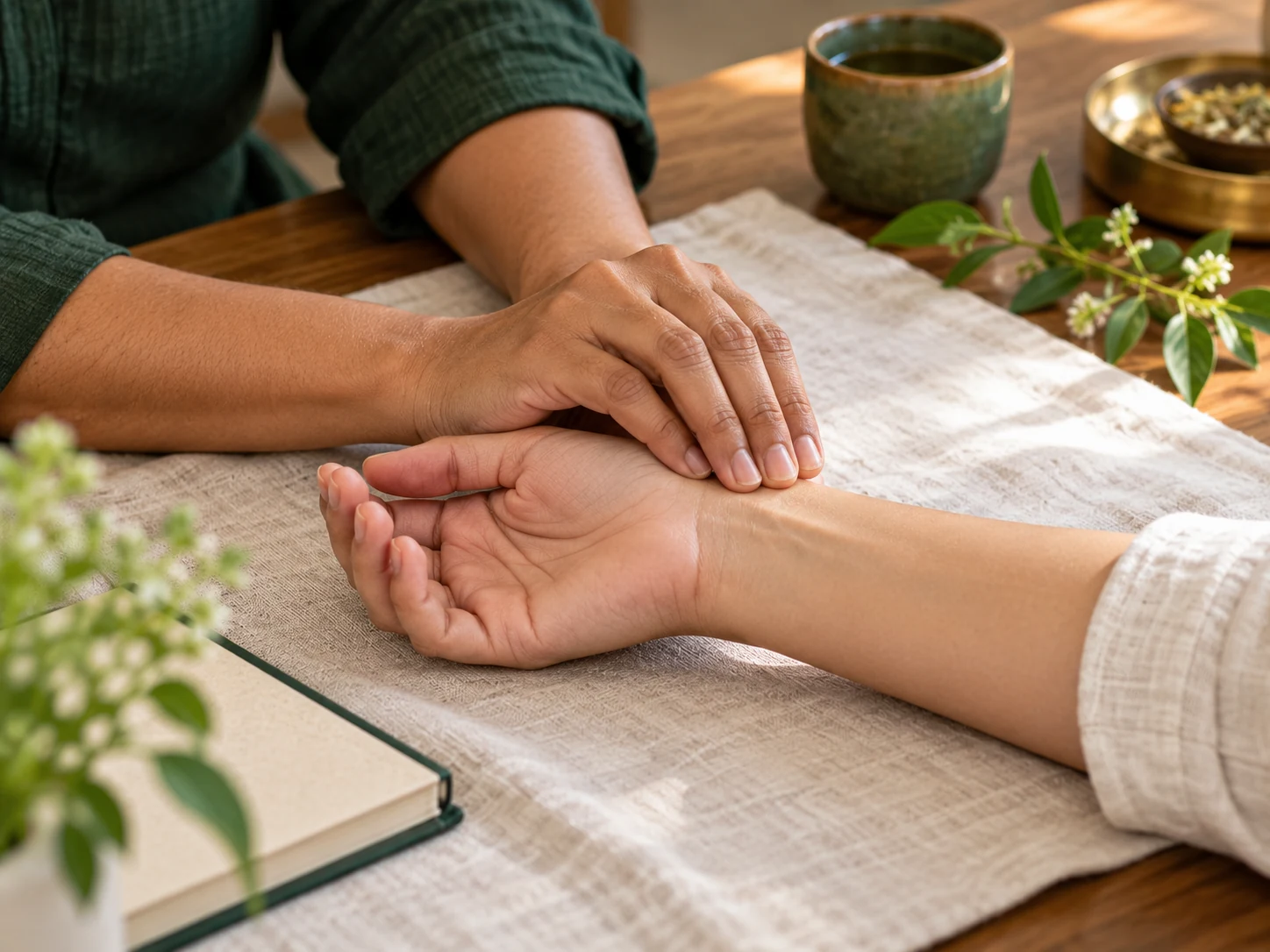
A first visit can explore appetite, digestion, sleep, elimination, energy, food, work, climate, and existing care. Traditional assessment may include observation and nadi pariksha, or pulse reading, as one part of a wider inquiry. A practitioner considers the story and the person together, rather than treating an isolated pulse impression as the whole answer.
2. Dosha and constitution
Vata, pitta, and kapha provide an Ayurvedic vocabulary for movement, transformation, and structure. The tradition distinguishes prakriti, constitutional tendencies, from vikriti, a present pattern. A practitioner may consider both with appetite, season, energy, and routine to decide which qualities deserve attention. Explore the three doshas.
3. Food and daily routine
Ahara (food), dinacharya (daily regimen), and ritucharya (seasonal regimen) are substantial parts of Ayurvedic practice. How a meal is prepared, when it is eaten, and how the day makes room for rest and movement can be discussed in detail. A useful plan is specific enough to try and flexible enough to fit the person.
4. Botanicals and formulations
Traditional texts describe a wide range of botanicals and compound preparations. Their selection depends on the person, the intended purpose, and the precise formula. Ask for the complete ingredient list, dose, manufacturer, quality testing, possible interactions, and the reason it is being considered. Supplements can interact with medicines, and some Ayurvedic products have contained harmful levels of heavy metals. See the supplemental therapy discussion.
5. Body practices and touch
Abhyanga (oil application or massage), Shirodhara (a steady liquid flow over the forehead), and other traditional body approaches have different purposes and settings. A practitioner can explain which technique is relevant to the person’s pattern and how it is prepared. Discuss training, hygiene, temperature, allergies, suitability, and local availability before a session. Learn about Shirodhara.
6. Panchakarma is a separate category
The five classical Panchakarma procedures form a distinct category of selected shodhana interventions, with preparation and recovery as part of the process. Some are forceful or invasive and require appropriate safeguards. Read about the five processes, their individual purposes, and the assessment that precedes them.
Choosing an approach with care
An Ayurvedic conversation can explain the traditional rationale for an option, what the practice actually offers, and how it might fit your goals. If a product or hands-on procedure is considered, ask about ingredients, preparation, training, suitability, and cost. Share relevant conditions and medicines so a traditional choice is made with the full picture in view. The aim is an informed personal decision, not a technique chosen because it sounds impressive.
Further reading
The Directorate of AYUSH account of classical texts shows the breadth of the tradition; its principles guide explains the traditional framework. The NCCIH overview discusses evidence and product safety.
This guide explains classical Ayurvedic ideas for general education. Personal recommendations depend on an individual conversation, your health history, and the suitability of a particular approach.
Back to resources